For Home
Take control of your home's energy. Store solar power, reduce costs, and enjoy greater independence.
All Products
Helpful Tools
Channels
Stories


Take control of your home's energy. Store solar power, reduce costs, and enjoy greater independence.
All Products
Helpful Tools
Channels
Stories
Smart energy solutions that put cost control and energy security back in your hands.
All Products
Helpful Tools
Channels
Stories
We offer a fully integrated system for installers, streamlining from design to post-installation services.
Start Here
SolisStorage service keeps you on the sunny side - expert support for all our systems.
Self-Service
Technical Support
Community & Insights
● EverCore is an integrated C&I energy storage system from SolisStorage, built around a 100 kWh, 120 kWh or 261 kWh battery cabinet and configurable with hybrid inverters from 30 kW to 125 kW. Inverter selection depends on grid voltage: on a three-phase 380/400 V grid, the 100 kWh cabinet takes 30/40/50 kW, the 120 kWh cabinet 30/40/50/60 kW, and the 261 kWh cabinet 80/100/125 kW. On a three-phase 220/230 V grid, 100 and 120 kWh cabinets take 30/35 kW, and the 261 kWh cabinet 60/75 kW.
● The system scales to 1.25 MW / 15.66 MWh through AC and DC expansion, needs no DC combiner cabinet because busbars are built into the battery cabinet, and switches to backup power in under 10 ms using an integrated STS.
● Safety and durability are certified rather than asserted: UL 9540A thermal runaway testing, IEC 62933 certification, a 15-level protection architecture from cell to cabinet to full system, and LFP cells rated for ≥10,000 cycles.
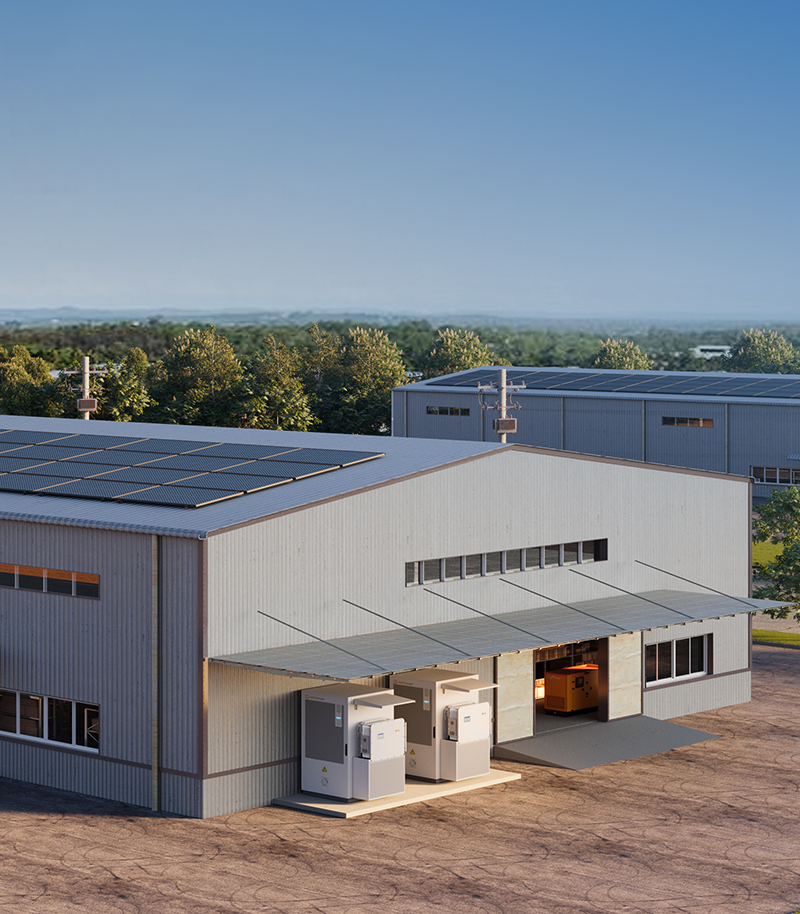
EverCore is a cabinet-type integrated energy storage system in which the battery cabinet and the hybrid inverter remain two separate physical enclosures, factory-married into one installed unit.
Most C&I cabinets put everything inside a single shell, which concentrates heat and turns any component fault into a whole-system event. EverCore separates the two: an IP55 battery cabinet with C5 anti-corrosion and an IP66 hybrid inverter, mounted together and commissioned as one block. Battery-side wiring and busbars arrive pre-installed, so on-site work reduces to mounting and plugging.
| Item | Value |
|---|---|
| Product category | Integrated C&I energy storage system (ESS) |
| Battery cabinet options | 100.48 / 120.57 / 261.24 kWh nominal |
| Inverter range | 30 – 125 kW, IP66 |
| Grid voltage options | 3/N/PE 220/380 V, 230/400 V (HV) · 3/N/PE 127/220 V, 133/230 V (LV) |
| Max. cycle rate / DoD | 0.5 P / 100% |
| Battery chemistry | EVE LFP 3.2 V / 314 Ah, ≥10,000 cycles |
| Operating temperature | −25 °C to 55 °C |
| Max. operating altitude | 4000 m |
| Protection | IP55 cabinet + IP66 inverter, C5 anti-corrosion |
| Noise | 70 dB(A) @1 m (100/120 kWh), 75 dB(A) @1 m (261 kWh) |
| Expansion | AC and DC expansion, up to 1.25 MW / 15.66 MWh |
| Max. parallel quantity | 10 units |
| Backup switch time | <10 ms |
| Certification | UL 9540A testing · IEC 62933 · IEC 62619 · IEC 61000-6-2/-6-4 · IEC 62040 · IEC 63056 · IEC 62477 · UN 38.3 |
The battery cabinet determines the energy, the grid voltage determines which inverter family applies, and within that family the inverter rating is a free choice — which turns "which model do I order" into two independent decisions.
| Battery cabinet | Battery configuration | 380/400 V grid | 220/230 V grid |
|---|---|---|---|
| EverCore 100 kWh | 1P10S · 320 V rated · 280–360 V · 5 packs | 30 / 40 / 50 kW | 30 / 35 kW |
| EverCore 120 kWh | 1P20S · 384 V rated · 348–432 V · 6 packs | 30 / 40 / 50 / 60 kW | 30 / 35 kW |
| EverCore 261 kWh | 1P26S · 832 V rated · 754–936 V · 13 packs | 80 / 100 / 125 kW | 60 / 75 kW |
All three cabinets share the same 20.09 kWh pack, built from LFP 3.2 V / 314 Ah cells at 138 kg per pack, and the same 157 A rated DC current. What changes is the string configuration and therefore the DC voltage class — 320 V, 384 V and 832 V.
The three most frequently specified pairings remain 100 kWh / 50 kW, 120 kWh / 60 kW and 261 kWh / 125 kW. They are no longer the only options: each cabinet now accepts a range, so a site can be matched to its demand profile instead of being rounded up to the next package.
| Parameter | 100 kWh | 120 kWh | 261 kWh |
|---|---|---|---|
| Rated energy capacity | 100.48 kWh | 120.57 kWh | 261.24 kWh |
| Dimensions (W×H×D) | 1250 × 2030 × 1540 mm | 1650 × 2030 × 1540 mm | 1850 × 2230 × 1600 mm |
| Dimensions without inverter | 950 × 2030 × 1540 mm | 950 × 2030 × 1540 mm | 1400 × 2230 × 1600 mm |
| Net weight | 1500 kg cabinet + 76 kg inverter | 1650 kg cabinet + 76 kg inverter | 2650 kg cabinet + 170 kg inverter |
| Operating temperature | colspan: −25 °C to 55 °C | ||
| Storage temperature | colspan: −20 to 45 °C (<1 month) · 0 to 35 °C (<12 months) | ||
| Operating humidity | colspan: ≤95% (non-condensing) | ||
| Max. operating altitude | colspan: 4000 m | ||
| Thermal control mode | colspan: Industrial-grade air conditioning (cabinet) · air cooling (pack) · intelligent fan cooling (inverter) | ||
| Ingress protection | colspan: IP55 cabinet + IP66 inverter | ||
| Anti-corrosion class | colspan: C5 cabinet + C5 inverter | ||
| Noise (rated operation) | 70 dB(A) @1 m | 70 dB(A) @1 m | 75 dB(A) @1 m |
| Protection mode | colspan: anti-islanding · residual current detection · insulation resistance detection · AC overcurrent · AC cable connection protection | ||
| Lightning protection | colspan: Type II (AC port) · Type II (PV/battery) | ||
| Cell / cycle life | colspan: LFP 3.2 V / 314 Ah · ≥10,000 cycles | ||
| Max. parallel quantity | colspan: 10 units (on/off-grid) |
Inverter electrical parameters — HV (220/380 V, 230/400 V grids)
| Parameter | 30 kW | 40 kW | 50 kW | 60 kW | 80 kW | 100 kW | 125 kW |
|---|---|---|---|---|---|---|---|
| Rated output current (230 V / 400 V) | 45.6 / 43.3 A | 60.8 / 57.7 A | 76 / 72.2 A | 91.2 / 86.6 A | 121.6 / 115.5 A | 151.9 / 144.3 A | 189.9 / 180.4 A |
| Off-grid overload | 1.5× 10 s | 1.5× 10 s | 1.5× 10 s | 1.5× 10 s | 1.6× 10 s | 1.4× 10 s | 1.4× 10 s |
| Recommended max. PV input | 60 kW | 80 kW | 100 kW | 120 kW | 160 kW | 200 kW | 250 kW |
| MPPT / input strings | 3 / 6 | 3 / 6 | 3 / 6 | 4 / 8 | 10 / 20 | 10 / 20 | 10 / 20 |
| Max. input current | 3 × 42 A | 3 × 42 A | 3 × 42 A | 4 × 42 A | 10 × 42 A | 10 × 42 A | 10 × 42 A |
| MPPT voltage range | 150 – 850 V (30–60 kW) | 150 – 950 V (80–125 kW) |
Common to all ratings: maximum PV input voltage 1000 V, rated 600 V, start-up 180 V, rated grid frequency 50/60 Hz with a 45–55 / 55–65 Hz window, power factor >0.99 (0.8 leading to 0.8 lagging), THDi <2% / THDv <3%, backup switch time <10 ms.
Inverter electrical parameters — LV (127/220 V, 133/230 V grids)
| Parameter | 100 kWh · 30 kW | 100 kWh · 35 kW | 120 kWh · 30 kW | 120 kWh · 35 kW | 261 kWh · 60 kW | 261 kWh · 75 kW |
|---|---|---|---|---|---|---|
| Rated output current (220 V / 230 V) | 78.7 / 75.3 A | 91.8 / 87.8 A | 78.7 / 75.3 A | 91.8 / 87.8 A | 157.5 / 150.6 A | 196.8 / 188.2 A |
| Off-grid overload | 1.5× 10 s | 1.5× 10 s | 1.5× 10 s | 1.5× 10 s | 1.6× 10 s | 1.4× 10 s |
| Max. usable PV input | 60 kW | 70 kW | 60 kW | 70 kW | 120 kW | 150 kW |
| MPPT voltage range | 150 – 850 V | 150 – 950 V |
1. Separated AC and DC architecture — four-layer separation for safer operation and true plug-and-play installation
2. Integrated four-in-one power electronics — PCS, PV, STS and EMS in one module with a single centralised controller
3. Designed for all environments, with optimised thermal management
4. Designed for easy maintenance and lower operating costs
5. Triple-layer system safety protection, certified to UL 9540A and IEC 62933
6. Open software platform with broad compatibility
Separation is applied across four layers: structural, safety, thermal and protective. Together they deliver two things that are hard to get in an integrated cabinet — safer operation, and an installation that behaves like a PV plant rather than a bespoke battery room.
1.1 Structural separation — busbars inside, no DC combiner
The battery cabinet carries its own internal busbars, so multiple battery clusters can be paralleled without a DC combiner cabinet. That combiner would otherwise be an extra enclosure, extra DC cabling, extra terminations — and one more failure point. Because the DC side is pre-wired, on-site assembly is three steps: install the inverter with standard PV methods, connect the pre-terminated plugs, complete one-click commissioning.
1.2 Safety separation
Integrated cabinets are usually qualified as one fire classification for the entire product. EverCore keeps the fire boundary local to the affected compartment, which is what allows the battery enclosure and the inverter to carry different ingress ratings — IP55 and IP66 — while remaining one system.
1.3 Thermal separation
In a single-shell cabinet the inverter's losses are dumped into the same air volume as the cells. EverCore keeps 3.5 kW of heat inside the battery enclosure, against 9.5 kW in conventional integrated designs. The datasheet reflects the same principle in its cooling design: air conditioning for the cabinet, air cooling for the packs, fan cooling for the inverter — three independent loops.
1.4 Protective separation
Two protection domains rather than one: an inverter fault no longer compromises the battery enclosure, and a battery-side event does not consume the inverter. Reported outcome: a 50% reduction in failure rate.
1.5 Flexible matching and dual expansion
The same cabinet accepts any inverter from 30 to 125 kW, and the system supports both AC and DC expansion, scalable to 1.25 MW / 15.66 MWh.
Four functions normally delivered as four products — PCS, PV, STS and EMS — integrated into one module under a single centralised controller.
2.1 One controller, one display — conventional systems run separate controllers with no single point of control. EverCore reports system data locally on a 7-inch LCD display with Bluetooth, so commissioning and first-line diagnosis happen at the cabinet.
2.2 No extra STS module — integrated static transfer switch, backup switching under 10 ms with no additional equipment. A conventional architecture needs an STS module plus a system cabinet; EverCore needs neither.
2.3 No additional PV inverter, 200% oversizing — PV connects directly, and the inverter accepts up to 200% oversizing (250 kW recommended PV input against a 125 kW rating). An oversized array produces more across the day; midday surplus is clipped rather than lost, harvested into the battery.
2.4 160% overload off-grid — supports 160% overload for 200 ms, enough to start pumps, compressors and refrigeration that draw several times rated current for a fraction of a second.
IP66 inverter · IP55 cabinet · C5 anti-corrosion (both) · 4000 m altitude · −25 to 55 °C.
3.1 Hybrid air duct design, up to 30% better thermal efficiency
Cooling usually fails on uniformity: cells near the inlet run cool, cells at the far end run hot, and the pack ages unevenly. The hybrid air duct design delivers up to 30% improved thermal management efficiency, across three separate loops — industrial-grade air conditioning for the cabinet, air cooling for the packs, intelligent fan cooling for the inverter.
Even cooling is not a comfort feature. A uniformly cooled pack can run closer to its rated 0.5 P cycle rate for longer, holds 100% usable depth of discharge, and reaches its ≥10,000 cycle life instead of being curtailed by a persistent hot spot.
3.2 Environmental envelope — storage limits of −20 to 45 °C for under one month and 0 to 35 °C for up to twelve months at ≤95% non-condensing humidity; Type II lightning protection on AC and PV/battery ports.
4.1 Separated, air-cooled architecture — liquid-cooled systems carry a compressor, coolant loop and service regime. EverCore's separated air-cooled design reduces system complexity and service time: the inverter is a discrete replaceable enclosure, packs are accessible at 138 kg each, and there is no coolant to test, top up or leak.
The service surface is deliberately short — the product documentation identifies three typical failure points (fan damage, air-duct resistance change, compressor damage) and a four-step pack replacement:
| Metric | Value | Implication |
|---|---|---|
| Typical failure points | 3 (fan damage, air-duct resistance change, compressor damage) | Short, predictable checklist |
| Pack replacement | 4 steps (disconnect, remove, install new, reconnect) | Routine swap, not a rebuild |
| Pack weight / tools | 138 kg, standard portable tools | No specialist lifting gear |
| Service crew | Two-person operation | Lower labour cost per visit |
| Tooling | General-purpose only | No rental cost |
4.2 Industrial-grade components designed for long-term, maintenance-free operation. Two components that normally dominate scheduled maintenance are both specified for a maintenance-free service life:
● Pack cooling fan: Minebea fans, widely adopted in PV inverters and proven in long-term grid-connected field service — 10 years maintenance-free
● Combustible gas detection: industrial-grade detector with a 10-year calibration-free feature, versus professional calibration every six months (≈1 hour per session, twice yearly) on conventional detectors
This converts the service contract from a recurring cost line into a monitoring task: fewer scheduled interventions, fewer specialist visits, shorter mean time to repair, because a fault is isolated to one of two enclosures rather than diagnosed inside a single shell.
"Maintenance-free" refers to component design life, not an absence of inspection. A 4000 m altitude rating and a high daily cycle count still require periodic verification, and grid-code obligations do not disappear.
5.1 Fifteen levels from cell to cabinet to full system, with layered detection and isolation designed to contain extreme scenarios rather than only to alarm on them.
| Grade | Fire suppression configuration |
|---|---|
| Default | Aerosol · explosion relief valve · fire water inlet · audible and visual alarm · flammable gas detector |
| PRO | Aerosol · explosion relief valve · fire water inlet · audible and visual alarm · explosion relief panel · explosion-proof exhaust fan |
Both grades share detection (flammable gas), pressure management (explosion relief valve), suppression (aerosol, fire water inlet) and notification (audible and visual alarm). PRO adds active venting for enclosed or high-risk locations.
5.2 Certified, not just claimed
● UL 9540A — test method for evaluating thermal runaway fire propagation in battery energy storage systems; the reference standard for fire-code compliance in North America and increasingly requested elsewhere.
● IEC 62933 — international standard for grid-integrated electrical energy storage systems.
Alongside IEC 62619 (battery safety), IEC 61000-6-2/-6-4 (EMC), IEC 62477 (power electronics safety) and UN 38.3 (transport).
5.3 Electrical protection at every level — anti-islanding protection, residual current detection, insulation resistance detection, AC overcurrent protection and AC cable connection protection, with Type II surge protection on AC and PV/battery ports.
5.4 Cell choice as a safety parameter
| Parameter | Other 280 Ah | EVE 314 Ah | Why it matters |
|---|---|---|---|
| Internal resistance | 0.17 ± 0.05 mΩ | 0.15 ± 0.05 mΩ | 20% less heat generation per ampere-hour moved |
| System cycle life | LFP, rated ≥10,000 cycles at 25 °C, 0.5 P, 100% DOD, SOH ≥60% | Lower internal resistance is the mechanism behind the rating |
The EVE cell is designed specifically for C&I energy storage, with ultra-low internal resistance to extend cycle life and enhance safety. Lower internal resistance means less heat for the same energy throughput, which is what allows a 0.5 P cycle rate at 100% DOD without accelerated ageing. The ≥10,000 cycle figure is a cell-level test result under those specific conditions — conditions matter when comparing against competitors quoting a different end-of-life criterion.
SolisCloud provides remote monitoring, digitised O&M and wireless updates — one fleet view across mixed sites, with no site visit needed to change a setpoint or push firmware. SolisCloud currently reports 300,000 systems connected across the energy storage fleet.
Solis AI sits on that data layer with forecasting, intelligent dispatch and revenue optimisation. Deployment scale and results:
● 4,800+ energy storage systems deployed with Solis AI
● Up to 302.6% estimated annual electricity cost savings in a Latvian deployment, comparing the SOC curve under Solis AI dispatch against the same system without AI intervention
302.6% is a project-specific estimate from one Latvian deployment under a particular tariff structure (wholesale Nord Pool and retail FlexPeak pricing) — not a general performance guarantee. It illustrates the size of the arbitrage opportunity automated dispatch can capture.
Third-party EMS and remote scheduling compatibility — proprietary EMS platforms are the main reason storage assets get stranded outside flexibility markets. EverCore is deliberately open: onboarded or onboarding with 102 third-party VPP/EMS manufacturers across 11 European countries, including Octopus/Kraken (UK), Check Watt/Krane/NextWatt (Nordic), Evergen (Ireland), SIA MVBK (Latvia), Zenly/Solecon (Estonia), Sonnen Power (Romania) and PLEXLOG (DE/AT/CH). For a developer, that list is the practical definition of bankable: the asset can be dispatched by whichever aggregator the market requires, without a gateway replacement.
A storage asset is only as valuable as the markets it can reach. Forecast quality determines how well a single site arbitrages its own tariff; EMS/VPP compatibility determines whether it can also earn from grid services. The second is a contractual question, not an algorithmic one — which is why compatibility breadth belongs in the datasheet, not the brochure.
| Dimension | Conventional integrated cabinet | EverCore |
|---|---|---|
| DC combiner | Separate DC combiner cabinet required | Busbars built in — no DC combiner cabinet |
| Heat in battery enclosure | ≈9.5 kW | ≈3.5 kW |
| Failure rate | Baseline | −50% through protective separation |
| Control architecture | Multiple independent controllers | Single centralised controller, 7-inch LCD + Bluetooth |
| Grid transfer | External STS module plus system cabinet | Integrated STS, <10 ms, no additional equipment |
| PV integration | Separate PV inverter, 1:1 sizing | Direct PV input, up to 200% oversizing |
| Off-grid motor starting | Limited by inverter peak rating | 160% overload for 200 ms |
| Inverter matching | Fixed factory pairing | Any rating from 30 to 125 kW per cabinet |
| Scalability | Often capped by cabinet count | 1.25 MW / 15.66 MWh, 10 units parallel |
| Safety evidence | Vendor claims | UL 9540A testing, IEC 62933, 15-level protection |
| Cooling | Liquid loop with compressor service regime | Separated air-cooled, three independent loops |
Step 1 — Battery cabinet by energy requirement
● 100 kWh (100.48 kWh, 5 packs) — small commercial loads, single-site demand charge management, backup for a compact facility
● 120 kWh (120.57 kWh, 6 packs) — retail, light industrial and small logistics sites, typically with a modest PV array
● 261 kWh (261.24 kWh, 13 packs) — base unit for larger plants; up to 10 units in parallel reaches 15.66 MWh
Step 2 — Inverter rating by load profile and grid
● On a 380/400 V grid: 100 kWh → 30–50 kW; 120 kWh → 30–60 kW; 261 kWh → 80–125 kW
● On a 220/230 V grid: 100 and 120 kWh → 30 or 35 kW; 261 kWh → 60 or 75 kW
Sanity check: at 0.5 P, a 261 kWh cabinet corresponds to roughly 130 kW of throughput. The 125 kW inverter runs close to full power; 100 kW is about 0.38 P and 80 kW about 0.31 P — progressively longer duration for the same energy, at lower inverter cost.
Sizing caution: the inverter must also carry the site's peak load in backup mode, not just the battery's power capability. If the critical load includes motors, size against the overload window (160% for 200 ms, or 1.5× for 10 s on smaller ratings), and check the largest motor's starting current separately.
Where EverCore fits — new standard industrial parks, large factories, logistics parks and commercial complexes; data centers and precision manufacturing needing high-reliability backup; extreme temperature and high-altitude regions; distributed PV above 1 MW; multi-parallel C&I stations, park-shared storage and grid-tied micro-grids.
What models does EverCore come in?
Three battery cabinets — 100.48 kWh, 120.57 kWh, 261.24 kWh. On a 380/400 V grid: 100 kWh → 30/40/50 kW, 120 kWh → 30/40/50/60 kW, 261 kWh → 80/100/125 kW. On a 220/230 V grid: 100 and 120 kWh → 30/35 kW, 261 kWh → 60/75 kW.
What is the difference between HV and LV configurations?
Same battery cabinet, different inverter family by grid voltage. HV connects to 3/N/PE 220/380 V or 230/400 V and runs 30–125 kW; LV connects to 3/N/PE 127/220 V or 133/230 V and runs 30–75 kW.
Does EverCore need a DC combiner cabinet?
No — the battery cabinet has internal busbars, so clusters parallel without one. That removes an enclosure, its DC cabling and terminations, and a failure point.
How much can one installation scale?
AC and DC expansion to 1.25 MW / 15.66 MWh, max 10 units in parallel on or off grid.
What safety certifications does it hold?
UL 9540A thermal runaway testing and IEC 62933, plus IEC 62619, IEC 61000-6-2/-6-4, IEC 62040, IEC 63056, IEC 62477 and UN 38.3. Protection is 15-level across cell, cabinet and system layers.
How much maintenance does it need?
Three typical failure points (fan damage, air-duct resistance change, compressor damage); four-step pack swap with standard portable tools at 138 kg, two people; Minebea fan rated 10 years maintenance-free; combustible gas detector calibration-free for 10 years.
How long does the battery last?
EVE LFP 3.2 V / 314 Ah cells rated ≥10,000 cycles at 25 °C, 0.5 P, 100% DOD, SOH ≥60%. Internal resistance 0.15 ± 0.05 mΩ — about 20% lower than a typical 280 Ah cell.
What does 200% PV oversizing mean?
A PV array up to twice the AC rating — 250 kW recommended PV input against a 125 kW inverter. Midday surplus is clipped rather than lost; harvested energy goes to the battery.
Can it start motors or run off-grid?
Yes — 160% overload for 200 ms, 1.5× for 10 s on 30–60 kW, 1.6× on 80 kW, 1.4× on 100–125 kW. Backup switching under 10 ms, no external STS.
What environments is it rated for?
IP55 cabinet, IP66 inverter, C5 both, −25 to 55 °C, up to 4000 m, ≤95% RH non-condensing, Type II lightning protection. Storage: −20 to 45 °C under one month; 0 to 35 °C up to twelve months.
How much space and weight?
100 kWh: 1250 × 2030 × 1540 mm, 1500 kg + 76 kg inverter. 120 kWh: 1650 × 2030 × 1540 mm, 1650 kg + 76 kg. 261 kWh: 1850 × 2230 × 1600 mm, 2650 kg + 170 kg. Noise 70 dB(A) @1 m (100/120), 75 dB(A) (261).
Can a third-party VPP or EMS dispatch it?
Yes — SolisCloud for monitoring and OTA, Solis AI for forecasting and dispatch, with broad EMS/VPP compatibility.
Suitable for a site with existing grid-connected PV?
Yes — direct PV connection, array up to 2× the inverter rating, PV keeps producing during a grid outage in off-grid mode.
● PCS — power conversion system; bidirectional converter between DC battery and AC grid
● STS — static transfer switch; transfers load between grid and inverter in milliseconds, often a separate cabinet in C&I systems
● EMS — energy management system; control layer deciding when to charge, discharge or hold
● DC combiner cabinet — enclosure paralleling battery clusters before the inverter; eliminated in EverCore by internal busbars
● PV oversizing — PV capacity above the inverter's AC rating to raise daily yield; 200% means twice the rating
● 1P10S / 1P20S / 1P26S — one parallel string of 10, 20 or 26 series-connected cells per pack
● 0.5 P — charge/discharge power equal to half rated energy per hour; 261 kWh at 0.5 P ≈ 130 kW
● DOD — depth of discharge; 100% means the full rated capacity is usable
● UL 9540A — test method for evaluating thermal runaway fire propagation in battery energy storage systems
● IEC 62933 — international standard for grid-integrated electrical energy storage systems
● C5 — high corrosion-durability class for enclosures in coastal and heavily polluted atmospheres
● VPP — virtual power plant; aggregation platform dispatching distributed storage as one grid asset
Source note: all parameters are transcribed from the current SolisStorage EverCore product single page and the (100–261) kWh / (30–125) kW-NV and (30–75) kW-LV datasheets, which take precedence over earlier material where the two differ. Cycle life is a cell-level figure under datasheet test conditions (25 °C, 0.5 P, 100% DOD, SOH ≥60%). Service-profile, cell-brand and software-deployment figures — three failure points, four-step pack swap, Minebea fan, calibration-free gas detector, EVE cell, SolisCloud fleet size, Solis AI deployment results, third-party VPP/EMS compatibility list — derive from the six-technology solution documentation; the 302.6% figure is a single-project estimate. Verify final values against the datasheet revision supplied with your quotation.

Solis Global Support | EverCore Powers a Mexican Factory, Backed by Local Expertise
10-30,2026
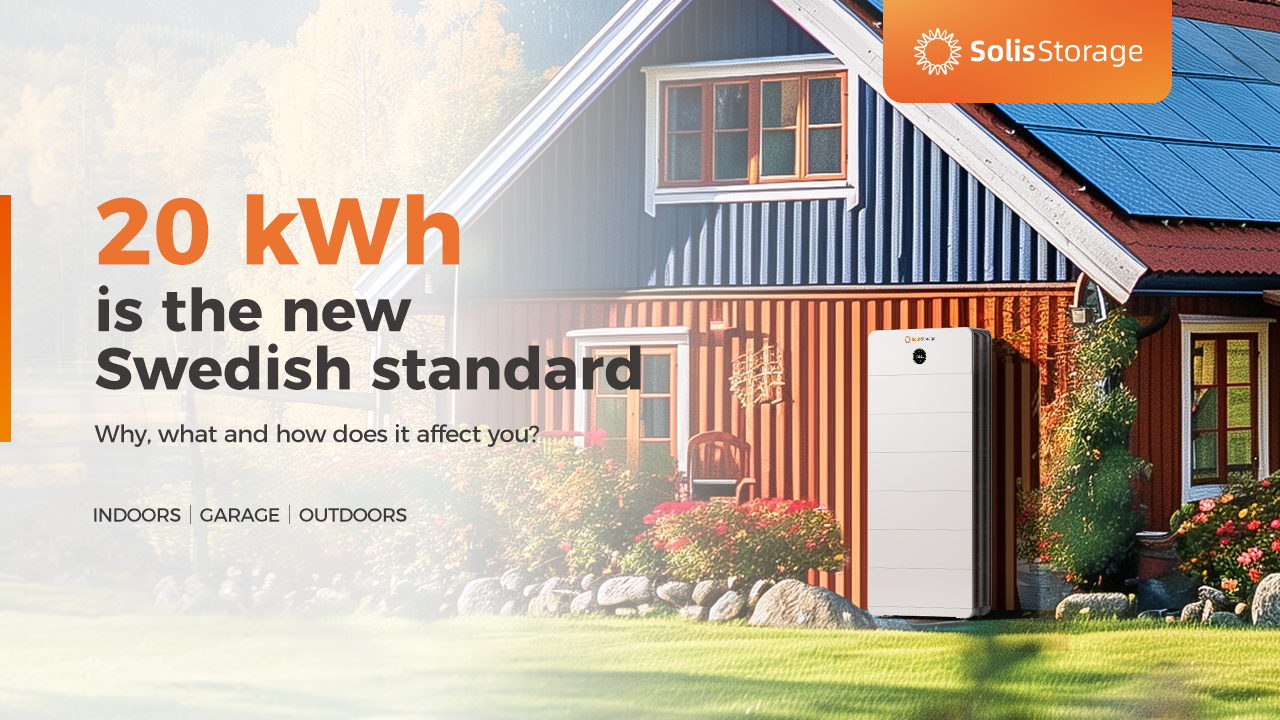
20 kWh is the new Swedish standard: why, what and how does it affect you?
08-03,2026

Is Solar Worth It in Sweden? How Solis AI Makes Home Energy Smarter
10-29,2026
K03-NV-ND-AU-官网banner_20261027172026.jpg)
More Solar for Everyday Life: Solis Highlights 10 kW Home Energy Solutions in Thailand
10-27,2026
I have read and agree to the Privacy Policy.
Newsletter
Join the SolisStorage newsletter for product news and updates.
I have read and agree to the Privacy Policy.
Online ChatOffice Hours:24/7
Start ChatSales Support
sales@solisstorage.comTechnical Support
service@solisstorage.com